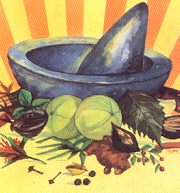
Ayurveda is a traditional Indian natural healing science which is over 5000 years old. It is a holistic health system based on human harmony
with nature.
It's origin is shrouded in the mists of time, but Ayurvedic
references are found in the Vedas the oldest known written records of
human civilization.
The Indian subcontinent contains about 25,000 species of vascular plants
of which around 7500 are used by folk and other traditional systems of
medicines. India is one of the major suppliers of medicinal plants to
the world. |
Ayurveda - An Introduction
AYURVEDIC HERBS
Ayurveda is known as the "mother of medicine" because Ayurvedic principles
have influenced the development of Chinese, Arabic, Greek and Roman schools
of medical thought. Modern western medicine has adopted Ayurvedic concepts,
as well as other more recently developed therapies like aromatherapy, homeopathy
and naturopathy. Ayurveda is a complete way of life. It is not only about treating sickness
- it is based on preventing disease and enhancing health, longevity and vitality.
The goal of Ayurveda is to achieve harmony and balance. This is attained without
drugs or invasive treatments. It is comprehensive natural method of treatment
ranging from diet, herbs, massage to life style counseling and meditation. A
balanced diet, herbal remedies, gentle exercise and physical therapies (such
as massage) are the main methods used. It also encourages one to a spiritual
life- style and the pursuit of self -realization. Yoga is also related to ayurveda
in that ayurveda shows how Yogic practices can be used on a therapeutic level
for treatment of diseases and for maintaining ones health. Ayurveda is recognized by the World Health Organization, and is currently used
by 70-80% of the Indian population. A WHO estimate reveals that around 80% of
the global population consume phyto-medicines and the emphasis on Ayurvedic
medicine is slowing shifting from under-developed countries to the developed
ones. Recently, Ayurveda has also become increasingly popular in the West. Ayurveda
is slowly entering into the mainstream health care being adopted by medical
doctors, naturopaths, chiropractors, herbalists and nutritionists.
Basic Concepts of Ayurveda
Disease in Ayurveda is due to an imbalance of three fundamental elements of
the body. These are VAATA, PITTA and KAPHA. The entire universe is made of five elements. (which are not material in the
usual sense of the term, and are types of energy.) For identifying them they
are called
- Akaasa (space)
- Vaayu ( air )
- Tejas ( light )
- Ap ( water )
- Prithvi( earth )
VAATA - Human bodies are mainly made of Akasa, Vaayu with a little of
Teja, Ap and Prithvi. Vaata is what allows one to interact with the environment.
Briefly, Vaata tramsmits sense impressions to the mind and responses to various
places of the body , maintains the integrity of the body and proper functioning
of its various constituent elements , the sensory organs of touch and sound
depend on vaata the waste matter from the body are transported by Vaata. It
stimulates Agni and produces joy. It forms the embryo in the womb into particular
shapes It is the evidence of life . PITTA - Is the primary constituent of the living body whose structure
is Tejas ( "luminous light"). Its function is balancing and transformative.
Its functions in particular are -- vision, digestion, production of heat, hunger,
thirst, softness and suppleness of body, lustre, cheerfullness and intelligence.
KAPHA - It is one of the primary constituents of the body, having "water"
and "earth" as elements. Function of pitta is conserving and stabilising . It
organises the tissues (into their microscopic and macroscopic form) .
|

 ©
www.indianmirror.com
©
www.indianmirror.com