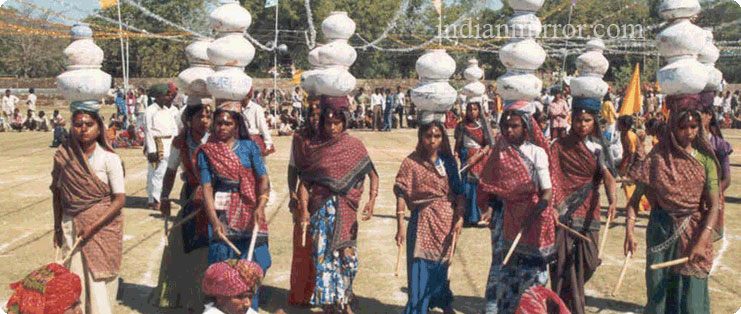
CASTE SYSTEM
In India, the caste system developed
and is prevalent since ancient times and it remains as a great thorn and mystery
in the flesh of Mother India.
It is believed to have been adopted by the Brahmins
to express their superiority and to maintain it. Then the Aryan races swept
into India from the North and they wanted them to be superior to the insiders
and so they maintained the prevalent caste systems. Gradually the caste system
became formalized into four major groups, each with its own rules and regulations
and code of conduct.
At the top rung of the caste ladder
in India comes the Brahmins who have maintained
themselves as priests and arbiters regarding religious and financial problems.
Then come the Kshatriyas or the
Soldiers and administrators. They are followed by the Vaisyas who are
the artists and commercial class members and lastly comes the Sudras who represent
the peasants and the farming class. According to the ancient Rishis these four
castes have come from the body of Lord Brahma, The Brahmins from his mouth,
the Kshatriyas from the arms, the Vaisyas from the thighs and the Sudras from
his feet. Each caste has further inner divisions, which are mainly controlled
by the type of work the person undertakes.
Behind all these comes the last sect
of people framed as untouchables or "Harijans" or "Children
of God" as called by Gandhiji.He worked a lot for their upliftment and betterment.
They are classified as the Scheduled Castes and they performed menial jobs but
now thanks to reservations, they have showed up in almost all High-level Departments.
Nowadays due to better education
and Westernization the caste system has weakened and is fragile, but for the
uneducated masses of India. Mostly Hinduism is based upon this caste system.
The other religions, which crept into India like Islam, Christianity, etc don't
profess caste divisions.
In an effort to improve the lot of
the lower caste people, the Government of India has come out with special packages
like Public sector jobs, Parliamentary seats and college seats for them. But
still caste systems pose a great threat for the upliftment of our country due
to frequent upheavals regarding reservations, etc.
But overall it helps in the grouping
of people into smaller units with common interests and goals, so that the culture
of the country is not lost due to the dispersion of its manpower.
THE INDIAN
WOMAN
India has almost an equal number
of men and women and almost half of the women belong to the uneducated category.
But now thanks to westernization and wide approval of education their number
is dwindling by the thousands. They have come out of their houses armed with
pens instead of spatulas so that they can get a decent position in the Indian
society.
The Indian girls mostly prefer arranged
marriages, by their parents and they take it naturally to deliver babies in
the coming year. In earlier times mostly boys were preferred to girls, as raising
girls, giving them education and then giving a hefty dowry seemed impossible.
But now they have come to terms with these practices. Most of the rural women
do the jobs of both a householder and a wage-earning laborer to make both ends
meet.
An Indian woman is best depicted
wearing flowers on her hair, with colorful bangles on her wrists and sporting
a lengthy sari neatly tucked in. Indian woman are noted for their pious nature
and they are mostly occupied by religious pujas of all sorts , fasts and prayers.
The Urban Middle Class woman has
become more or less comfortable with a satisfactory pay packet and work-reducing
kitchen gadgets for her. Yet she remains under pressure. She is expected to
fall in line with the patrilineal pattern of society and the nuclear family
structures.
One of the significant features
of the 20th century is the rising of women's movements. Different movements
have resulted in various women's issues being mainstreamed in the Indian
society. Women of today are making great inroads as getting around 30%
in Parliamentary seats and some allocations in the Armed forces. The voting
and legal rights of Indian woman has been relaxed and enhanced.
India gives its woman the image
of "Mother"
or "Devi" liable to great
reverence and worship. Women as Gods are part of the Indian tradition.
"Durga" one of the powerful deities in India, is a woman. Some of the
important temples in the country are dedicated to woman Goddesses.
Some percentage of woman have risen
to the top rung of the ladder in their respective fields like Indira Gandhi
in Politics, Medha Patker in social movements, P.T.Usha and Malleswari in Sports,
to name a few.India has more women in important positions
than any other country in the world.
MULTI- LINGUAL
COUNTRY
In India, English is used widely
as the associate official language, though eighteen languages have been adopted
by the Constitution. And there are around 1500 dialects local to the various
States and Union Territories of India.
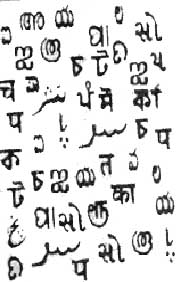
Indian languages
|
The main languages belong to
two categories namely, Indo- Aryan and Dravidian. The Indo Aryan languages
belong to the invaders of India and the Dravidian languages to the native
South Indians. Almost all the recognized languages have their own script.
For most of the Indians, English is the second language and the main mode
of education both for arts and science.
The 18 main languages are:
Assamese, Bengali, Gujarati,
Hindi, Kannada, Kashmiri, Konkani, Malayalam, Manipuri, Marathi, Nepali,
Oriya, Punjabi, Sanskrit, Sindhi, Tamil, Telugu and Urdu.
Hindi is the most important
language and it is spoken by about 20% - 40 % of the total population.
It is the official language of the Indian Government. It is the main language
in Bihar, Madhya Pradesh, Rajasthan and Uttar Pradesh.
The various literatures of India
have some common characteristics, which reveal their Indian ness, some threads,
which hold them despite their distinctive flavor and diverse associations.
SECULAR INDIA
India is a secular
country with total freedom of worship according to one's beliefs and faith.
Hinduism is the major religion followed by about 80% of the population.
Sikhism, Buddhism and Jainism had their roots in India and Zoroastrianism
and Christianity though they came from different parts of the world are
followed by a sizable number of the population. These religions have some
common rituals and practices and all of them stress on the importance of
God, the Supreme Being. Most
of the Indians believes in God and the efficacy of prayers. Indians spend
more time in the pursuit of religion, like prayers, rituals, pilgrimages,
fasts, discourses, etc, than any other people in the world.
Hinduism is one of the
oldest religions in India, possibly brought down by the Aryans. The Ramayana,
The Mahabharata, the Upanishads and The Bhagavad-Gita are the important books
of this religion and the people of this faith worship in temples. Their common
Gods include Shiva, Parvathi, Vishnu and Brahma. The Rishis and Sadhus who roam
the length and breadth of the country are considered to be the most pious in
Hinduism. They have certain holy rivers and towns, for which a visit once in
their lifetime is of great interest. The rivers include the Ganges, the Yamuna,
The Saryu, the Brahmaputra, TheCauvery, etc. The cities considered to be holy
are Varanasi, Ayodhya, Mathura, Dwarka, Kanchipuram, Ujjain, Badrinath, Puri
and Rameswaram to name a few.
Buddhism is followed
by about 7 million of the population of India. Gautama Buddha founded it in
the state of Bihar where he attained enlightment. The Mahayana and the Hinayana
are the two sects. Buddhism propagates the eight-fold path as the way to salvation.
The ancient ruler Asoka propagated this religion throughout India as well to
many foreign countries.
Islam is the biggest
minority religion in India and it is followed by around 10% of the population.
It was founded by Prophet Mohammed in Saudi Arabia and with the Arab invasion,
Islam penetrated to India. The Mughal Emperors nurtured it. India has some of
the biggest and beautiful mosques of the world.
Jainism is a contemporary
of Buddhism and Mahavir founded it. India has around 4 million of Jains mainly
concentrated in the west and south-west of India, namely the states of Maharastra
and Gujarat. The Jains are known for their ahimsa- doing no harm to any life,
principles. The two main sects of Jainism are the Svetambaras and the Digambaras.
Shravanabelagola, a village in Karnataka is a Jain pilgrimage spot.
Zoroastrianism, one of
the oldest religions of the world came to India from Persia. The Zoroastrians
are mainly concentrated in Mumbai city and to some extent in the state of Gujarat.
Their holy book is the Zend Avesta and they worship the Fire as their God. They
are noted for disposing of their dead brethen to birds as food. Their numbers
are gradually reducing in India due to compulsory inter-religious marriages.
Christianity came to India
around 50 A.D, with the arrival of St. Thomas in Kerala. The Christians number
around 20 millions in India. The Christians are mainly concentrated in Kerala,
Tamilnadu, Goa and the tiny states of Mizoram and Nagaland where the majority
of the people are Christians. Cochin in Kerala is noted for its famous Jewish
settlements.
JOINT FAMILY
SYSTEM
With Westernization and technological
improvements, the world has been introduced with the concept of nuclear families
where a newly- wed couple start their life alone. They have to nurture their
children with their own knowledge and earnings. Though this fever has caught
up in India to some extent, the rural parts, which form the main part of India,
still follow the joint family norms.
In such an Indian family the father,
mother, grandfather, grandmother, sons, daughters, sons-in -law, daughters-in
law, their children, etc all live under the same shade sharing the same food
and earnings. Such a gathering of almost three generations is a common sight
in many of India's villages. The men are the sole-bread winners and they are
responsible for the financial security aspect of the household. The women do
all the house chores without any hassles as they share their work of cooking,
cleaning, doing the dishes, washing, etc. This is in sharp contrast to the nuclear
woman, who has to do all the jobs, single-handedly, yet also attend to outside
work to make both ends meet. The children have a wonderful time as they have
lots of children to play with and elders to guide them both spiritually and
physically. But the modern day nuclear- kid comes home from school to find an
empty house with none to move around with and he would be fast asleep when his
parents return back from work.
Mostly the Patriarchal system is
followed throughout India, but in some states like Arunachal Pradesh in North
-West India, the matriarchal system is followed where the house is ruled by
the women members of the family and the men while their time by playing and
gossiping! Kerala also follows this system to some extent, in that its female
members control the decision making process in a family.
The joint family system transfers
its knowledge about the culture and traditions of the country to the new generations.
So the younger generation learns to live a disciplined life. Financial stability
is brought about in the family. Any imbalance between spouses is easily measured
out since there are many elders to guide and hence India has a low rate of divorcees
in the world.
EDUCATION
In ancient India, the Gurukul
system of education was followed where an overall knowledge was imparted to
the student who is to be away from home for most of his educative years. It
was a residential type of education with total submission to the Guru or teacher.
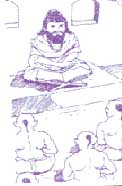
Gurukul
system
of Education |
The Indian system of education
is one of the best in the world, despite its high illiteracy rate. Education
in India is very disciplined with physical education also getting equal
importance. Indians are noted for their scientific and mathematical skills
even from ancient times. Aryabhatta and Bhaskara, Ramanujam etc were great
Indians who brought credit to the Indian system of education.
Later with foreign invasions,
alien culture swept India and many were forced to go out of the country
to get a decent education, as the educational system was in shambles.
Nehru, Gandhi and many Indians had to get educated from outside India.
With the withdrawal of the foreign forces and the introduction of English
into India by Lord Maculay, Indian educational system rose up like a Phoenix.
There are around 1000,000 schools
in the country with around 600, 000 dedicated for Primary Education alone. The
literacy rate is around 60 %, which is far greater when compared to the rate,
a decade earlier. But in general men have a high literacy rate, as most of the
village women are yet to come out of their veils of ignorance. The State of
Kerala boasts of cent percent literacy rate while some like Bihar are way back
with a literacy rate of around 40% only.
In the last decade, science and technology
studies have caught the fancy of the Indians who earlier took to law and finance.
Armed with such degrees they are a prey to many foreign firms. This brain drain
is now stemmed to some extent by competent pays and perks in India. Studying
at home at the grace of the World Wide Web or Net is now slowing
catching up in India, and this trend is likely to dominate the Indian culture
in the near future.
| 
 ©
www.indianmirror.com
©
www.indianmirror.com