


Seasons according to the Gregorian calendar:
 |
Spring |
February
end to March end. |
|
|
Summer |
April
first to June last. |
|
|
Rainy |
July
first to September last. |
|
|
Autumn |
October
month. |
|
|
Winter |
November
first to February end. |
HOLI
This is one of the most popular and colorful festival celebrated in India. It comes when the cold months give way to the summer. This most joyous festival falls on the full moon day during the month of Phalguna, sometimes-late March. It is seasonally the time when bodily humors change markedly, particularly the phlegm - thawing with the onset of summer. Hence, physiologically people in India, particularly in the north rave for more sensuous and sensual pleasures with both the sexes longing to mate!
Holi is generally associated with Lord Krishna, who in his childhood and adolescence ran around with his band of cowherds and maidens of the village. Another story goes like this: the demon named Hiranyakashyapu wanted all the people to worship him and not Lord Vishnu. But even his son Prahlad did not follow this. The demons tried all tricks to kill Prahlad but in vain. At last, Holika, the demon's sister vowed to kill her nephew. So she sat on a pile of firewood along with her nephew and asked the demons to set it ablaze. Since she had a boon as to she would not be killed by fire, she readily did this act, but to everyone's surprise she was killed but Prahlad was left unscathed, and to commemorate this death of evil, people started celebrating holi.
Before this day people sort out all unwanted things to be burnt on Holi day. This "holi" is set ablaze at a precise "Muhurta" on the eve of the actual holi day called Dhulendi. People gather around it singing and dancing in Joy on the beat of Dholas and Nagaras.
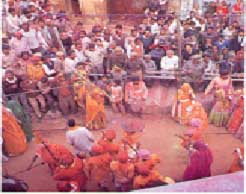
HOLI CELEBRATIONS
During these days sweet homemade cakes called Goojhas are prepared and offered to every guest. Apart from it "papri", "samosa", kachauris", "kanje ke bari", etc are also prepared. There is no particular Puja associated with Holi.
Holi for the people is a festival of joy revelry and of abandonment of all taboos and restrictions: to forget the innumerable obligations that weigh us down and breathe the air of freedom.
NAVROZE
This is the most celebrated festival of the Parsis. Every year on March 21, Navroze is celebrated. It is considered the Parsi New Year only by one sect of Parsis- the Faslis- but all Parsis join in the festivities and enjoy themselves and greet each other and attend the thanks-giving ceremonies at Fire Temples. March 21 is the first day of the spring and also the vernal equinox of the sun, and therefore a logical day to celebrate the beginning of yet another year. Hence the name "Navroze" which literally means the New Day.
The festival was celebrated as far back as the 6th century BC when Cyrus and Darius ruled over the Persian Empire. The celebration commences with cleaning the house, seeping out cobwebs, painting the whole house. New clothes would be ordered for the entire family. Garlands of roses and jasmine decorate all doors and windows. Steps and thresholds are marked with beautiful patterns in color powders like "Rangoli".
Food is also an important component in these celebrations. Parsi food is a blend of West Asian and Indian style of cooking. "Rava", the popular dish is cooked with Sooji, milk and sugar. When the mixture thickens, it is flavored with rose water and sprinkled with grated nutmegs. The other popular breakfast is fried vermicelli, cooked in sugar syrup and sprinkled with almonds and raisins.
Then they go to the fire temples for worship where they offer sandalwood sticks to the fire. It is customary for the Parsis to cover their heads once inside the temples. The children wear small round caps of gold and silver brocade, while men wear small black velvet caps. The women pull their sarees over their heads. After the prayers they greet one another by bear hugs and say "Sal Mubarak"- meaning may the coming year be prosperous.
Visitors to the house that day are offered sweets and a glass of "Faluda"- a sweet milky drink cooked with a special type of vermicelli flavored with rose essence and served chilled. Pulaos rich with saffron, fish steamed in banana leaves, chicken curries with ground almonds and plain rice and moong dal are considered to be appropriate lunch for the day.
Growing of wheat in small earthenware bowls was also an age-old custom of the Parsis. On the 13th day after the Navroze, they tossed these tiny sprouts of plants into the nearby water-head, as a means of reverence for the water and greenery.
BIHU
Bihu is the biggest festival of the people of the Assam region. This is truly a regional festival, which brings a sense of solidarity and unity among the people of the Assam region. It comes thrice a year and marks the changes in the seasons. The first of the three "Bihus" falls on "Chait Sankranthi". It is called Bihag Bihu or Rangoli bihu. In fact bihu is a festival to celebrate fertility. Rangoli Bihu is the most festive and joyful of all the Bihus. Other Bihus are known as Magh Bihu and Kati Bihu.
The Rangoli Bihu is a Spring New Year and agriculture festival, all rolled into one. The first day of Rangoli Bihu is known as Gori Bihu and is reserved for cattle rites. Household cattle get special attention and they are decorated with colorful garlands of flowers and given good food. The next day is called "Manuh Bihu". Paying homage to elders is customary on that day. On this day special meal is prepared with Chivra (flattened rice), curds and sweets. An attractive feature is the offering of presented called "Bhiguwan", which consists of a napkin woven by women in the family loom. The next day is "Gosain Bihu", which is reserved for religious services. The seventh day has the custom of the people preparing seven types of leafy vegetables called "SatSak ". Games and sports are also a necessary part of the Bihu celebrations. Children join them with great fervor.
The harvest festival celebrated in winter is the Magh Bihu when the crops have been harvested. Feasting forms the main feature of this Bihu. It is also connected with fire rites and the lighting of bonfires. On the bihu eve, every household has a special meal of fish and meat. Groups of young people and children hold community feasts in temporary structures made of dry hay and bamboo sticks.
The Bihu specialties among food items are "Chivra"(beaten rice), "Pitha"(rice cakes), "Laru"(sweet balls) of various kinds. These are eaten as mid-day meals. It is also customary for the young to get blessings from the older members of the family.
The last of the Bihus is the "Kati Bihu" which is a one-day celebration. It falls around October- November, when the paddy crops are yet to mature and the granaries are almost empty. Hence it is called "Kangali" or Poor Bihu.Naturally there is no feasting on this day. Special Tulsi Pujas are held on this day.
GOOD FRIDAY
This is one of the famous Christian festivals and it is observed on the Friday before Easter. It is celebrated in March- April to commemorate the crucifixion of Jesus Christ, who sacrificed himself for the entire humanity. On this Day, Christians mourn Christ's death and strictly fast and attend masses in the churches.
This is also called "Black Friday"- from the vestments of the clergy and the altar in the western church. One section of Christians call the Good Friday very auspicious and the other, ominous. Some Christians wear Black clothes to symbolize mourning and take out a procession with an image of Jesus Christ to the Cemetery belonging to their church. Dramas depicting the crucifixion of Jesus are enacted in many places and some churches ring the mourning bell as a mark of respect to the Lord.
EASTER
Easter marks the resurrection of Jesus Christ. It is a day of great rejoicing and merry-making for the Christians. This is celebrated between March 22nd and April 25th, on the Sunday following the full moon. Easter ceremonies correspond to Passover, the Jewish festival of yore.
Easter symbolizes the ultimate victory of good over evil. Feasts are given to the poor and the needy and sweets are exchanged. Joyous processions are taken out on this day. Edible as also artificial and hard-boiled eggs are given as gifts on Easter day. In short, the Christians congregate in large masses in churches and thank Jesus, the savior of the whole humanity on the occasion of Easter.