


MAHAVIR JAYANTHI
Both the Digambara and the Shwetambara Jains observe the birthday of Lord Mahavir, the Jain Teerthankar, on 13th day of the bright half of the Chaithra month as Mahavir Jayanthi. (March- April).
Though it is celebrated by Jains throughout the country, it is celebrated with great style and fervor in Rajasthan and Gujarat where the Jains are settled in large numbers. On this day Jain pilgrims from all over the country congregate at the ancient Jain shrines at Girnar and Palitana in Gujarat and at Mahavirji in Rajasthan, and Pawapuri, Vaishali in Bihar. Vaishali being the birthplace of Lord Mahavir, a grand festival is held here and it is known as Vaishali Mahotsava.
On this auspicious and holy day, grand chariot processions with the images of Mahavir are taken out. Rich ceremonies are held in the temples and fast and charities to the poor and the needy are done. On this day the Jain scriptures are devotedly read and in some places big fairs are held.
HANUMAN JAYANTHI
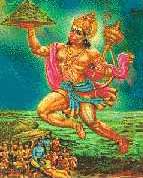
Lord Hanuman is known to give quick solutions to problems. He is also known as Sankat Mochan or the remover of distress and affliction. There is hardly any place in North India where there is no temple for the Lord Hanuman. So, his birthday is celebrated with great devotion. On chaithra Shukla Purnima- full moon day, generally falling between 15th March and 15th April, Hanuman Jayanthi is celebrated all over the country.
HANUMAN
JAYANTHI
Lord Vishnu came in the form of a beautiful Lady to deviate the demons and let the gods have the Amrita. Lord Shankar was so much attracted to the Lady that he chased her and prematurely ejaculated. The sages and seers did not want to waste the seed of shankar that they collected it and implanted it in the womb of Anjani and thus Lord Hanuman was born.
The birth anniversary of Hanuman is celebrated with great devotion. Devotees visit Hanuman shrines, observe fasts, offer prayers and puja and read the Ramayana. On this day the idols of Hanuman are given a special coating of vermilion mixed with clarified butter. People offer "besan Ladoo" or "Boondi" as prasad and chant various hymns eulogizing his glory.
GANAGAUR
Primarily a women's festival, Ganagur is celebrated on the third day of the bright half of Chaithra (March-April). It is a local festival in Rajasthan and is also celebrated in many parts of northern India with great fervor. Ganagaur is actively an 18-day festival culminating on the final day. The celebrations commence right from the next day of Holi with the worship and prayers to Gauri. Gauri is an epithet of Parvati, the eternal spouse of Lord Shiva.
Both the married and the unmarried girls worship the Goddess everyday during the festival with durva grass, fruits and bright glass pots filled with fresh water. The married woman seeks the blessings for faithful conjugal happiness and bliss while the virgins pray for a suitable handsome husband and future marital prosperity.
On the final day of Ganagaur festival, the ladies keep strict fast, worship the Goddess, wear colorful raiment and ornaments, exchange sweets and the earthen or wooden images of Ganagaur (Shiva- Parvathi) are taken out in processions through the main streets to the accompaniment of music for the immersion of the idols in the nearby lake. Normally Ganagaur is celebrated at the daybreak.
CHITHRAI FESTIVAL
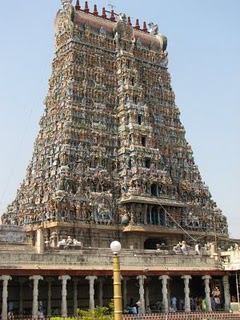
Madurai Meenakshi Temple
The wedding anniversary is called as Meenakshi Kalyanam, which is the most spectacular festival of Madurai. According to the legends, Indra set out on a pilgrimage to atone for the misdeeds he has done unknowingly. During his pilgrimage when he came near Madurai, he felt that the burden has lightened and he found a Shiv Linga lying there. He immediately built a beautiful temple there and installed the lingam there.
Then he desired to perform a puja and so Lord Shiva caused a Golden lotus to appear in the nearby pool, and that day happened to be a chaithrapoornima. The golden lotus lake is still inside the temple premises.
RAM NAVAMI
Ram Navami, the birthday of Lord Rama is a major Hindu festival celebrated all over the country by all sects of the Hindu fold. Ram, the seventh incarnation of Lord Vishnu was born on the ninth day of the bright half of the lunar month chaitra.
The festival preparations start early in the morning with people taking bath in the holy waters and coming to the temple of Lord Ram. They keep fast till 12, noon, when the avatar is supposed to have taken place. People take "Phalagar" only in the afternoon. It consists of a sweet made of khoya, potatoes or calacosia made in any form without the use of Haldi, garlic and onion. All kinds of root vegetables are consumed and no green vegetables. Fruits are allowed. The puja is done in the noon by singing various slokas, hymns and ending with the distribution of Panjeeree, chranamrita, fruits and sweets.
In Ayodhya, the birthplace of Sri Ram, the temples are heavily decorated and great festivities take place. Ramayana is read and recited and great fairs are held here on that day. Ran Navami is also celebrated as the Vasanta Navarathri festival with the celebrations starting from the first lunar day of the bright half of the chithrai month.
BAISAKHI
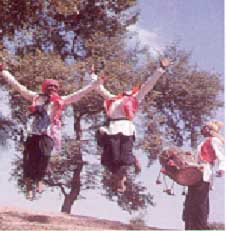
This harvest festival of Baisakhi is celebrated with the joy being expressed by the famous Bhangra dance. It is very important for the Sikhs, Buddhists and Hindus alike and is marked by the ritual bathing at Haridwar.
It falls on the 14th April and marks the beginning of the solar year for the north Indians, and it is called so because after this day, the month Baiskhi starts. But when an extra month is added to the year, this festival falls on the month of Baiskhi.During this festival the clime is very enjoyable and also the farmers have sufficient amount of money in their hands for the celebrations, since the harvests are over and the produce sold.
In the morning of Baisakhi, people take bath at rivers and tanks. Then dressed in new attires they go the Gurdwaras. There they give thanks for the good yield and pray for a similar result, the coming year. The day is considered very auspicious and big cattle fairs are conducted in many village grounds. Giant wheels and merry-go-rounds dot almost all the villages.
It was on this day that Guru Gobind Singh initiated the "Panch Piyara" or the five loved ones. He decorated the Khalsa at Anandpur sahib near Chandigarh and gave five people from five different states the rules on how to be like a true Sikh. One of the sacred places for the Sikhs is the Amritsar, Golden Temple. It has a huge tank in it and there is popular belief that anyone bathing in it gets purified of all his sins. On Baisakhi day, water is brought from all the sacred rivers of India and poured into that tank.
Lots of fruits like ber and lookat and mithai are sent to the houses of the daughters and sisters as gifts. Visitors are given lassi and mithai and many other festive foods.
BUDDHA PURNIMA
This is the most sacred day for the Buddhists all over the country. This full- moon day of the month of Vaisakh (April- May) has special significance, because on this day the Great Buddha was born, attained enlightenment and attained Nirvana or death. This strange, three-fold coincidence, gives Buddha Purnima its unique significance.
On the full moon day of Vaisakh the Buddha's mother, Queen Mahamaya, happened to be on her way from Kapilavastu to her parents home in Devdaha. During the journey itself she gave birth to her son under the shade of two Sal trees. And then this Gautama grew up but he was nor attached to worldly pleasures and sought a way out. Then on another full moon night of Vaisakh, on his thirty-fifth birthday he attained enlightenment.
On this day, the Buddhist people take bath and wear white clothes and visit the viharas and give alms to the monks there. Then they attend discourses on the life and teachings of the Buddha from the Buddhist monks there. On this day they refrain from eating meat. Their special forms of charity include kindness to animals; many of them buy caged birds and let them free. They make "Vaisakh Valkats" out of bamboo and decorate their houses with them. To the Buddhists it is not a day of great rejoicing but of deep reflections on the travails of human life in particular, because Buddha was the first to find a solution to the great causes of human grief.
NRIJALA EKADASHI
Ekadashi is believed to be the most pious day in a month in general for the devout Hindu. It comes twice in a month according to the Hindu calendar. It falls on the eleventh day of the waxing of the moon and again on the eleventh day of the waning of the moon. The observance of the rituals connected with this day are said to wipe away the sins that may have been done in the past fortnight. The very religious observe a fast on both the Ekadashis. The regulations for the fasts are nor very strict. Fruits, milks, sweets, tea and coffee can be taken along with water and a full meal can be taken in the night.
"Nirjala Ekadashi" comes in the Hindu month of Jyeshta, the 11th day of "Sukul Paksh" and comes sometimes in the month of June. The origin behind this festival goes like this; Bhim, the son of Kunti, was a great Gourmet. He hated the idea of fasting on every Ekadashi. So his mentors felt that atleast he should absolve of his sins and that it should be a total "Vrat".
In the morning of this day people get up early, take bath and wear ordinary clothes and perform puja. It is not a festive occasion but a sober one, where one is supposed to think of the humble and the poor. Everyone does the puja with water first and then with aipun and roli and lastly with rice, worshipping Ganesh and the appropriate deities.