


POORAM GOMATESHWARA
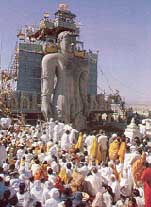
Once in every 12 years, the Mahamastakabhishekh or the ritual anointing of the giant monolithic statue of the great Jain saint Gomateshwara takes place.
Once the prayer is over they greet each other: Eid Mubarak! This festival is particularly the favorite of children. They are given special money called "Eidee" by their parents for buying toys and balloons on this day. Special delicacies are prepared. They include "Seviyan", vermicelli's sweet preparation, "Sheer Korma, and other savoury dishes.
PUSHKHAR FAIR
At the Pushkhar fair in Rajasthan, thousands of Bhil tribals gather at the junction of the Som and Mahi rivers in remembrance of their ancestors and take a holy dip. As most fairs, here also makeshift bazaars spring up everywhere near the vicinity and lot of buying and selling takes place.
TARNETAR FAIR
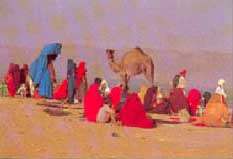
At Tarnetar in Gujarat, a huge three-day fair is held during the months of August- September. The Bharwads and Rabaris, the tribals of this area celebrate this fair elaborately. This fair is mostly taken, as a marriage mart where many betrothals take place and folk dances is also an important feature of this fair. Young men and women turn out in their best traditional dresses while the crowd gather around the Shiva temple of Triniteshwar.
KUMBH MELA
Kumbha means a pitcher or a water pot. When the ocean was churned and the nectar began to appear, there was a scramble for it between the gods and the demons that the contents splashed and fell at four places. These four places are Haridwar, Prayag, Ujjain and Nasik. Kumbh Parva or Mela is held every 12 years at rotation at these places. It is called Purana Kumbha and the ones held every 6 years in between the full ones is called Ardha Kumbha or half Kumbha. At Haridwar it lasts for about a month and half in Phalguna- Chaitra. At Prayag, it is held in Magh. The Ujjain Mela is held In Karthik and the Nasik one in Shravana month. These melas terminate with the final bathing on the new moon day. The Kumbh Fair is the most magnificent bathing festival ever held in the world. Millions of pilgrims including saints, sanyasis, rishis, priests, naga sadhus, mahants and milling crowds participate in it. Sometimes the crowd becomes unmanageable with serious stampedes that had consumed several hundreds of lives.
THE ECLIPSE
The time of eclipse is an occasion when the devotees take bath in the Ganges and other holy waters. They offer libations to the souls of their departed ancestors and offer water to the sun and the moon. At Kurushetra, where the famous Mahabharata war took place, thousands take a dip in the holy pool. A bath taken in the holy waters and charities done on this day purify the mind and the soul of the aspirant. On the eclipse day, widows, sadhus observe strict fast. People in general are prohibited from sleeping and touching the idols of their Gods. Meditation and recitation of the Gita, and charity are recommended during the eclipse.
MAL-MAAS (ADDITIONAL MONTH)
Mal- Maas is also called Adhikmas or Purushottam-mas. It is an inter calculated 13th month. In this month the sun does not move from one position to the other. It occurs after every 32 months, 15 days and 4 ghatis. During this religious ceremonies are prohibited. Fasts and charities observed on this day are considered to wipe off ones' sins. During Mal-maas, ghee, grains and jaggery are given in charity to the Brahmins. When Malmaas occurs in the months of Vaishakha or Jyaishtha or Ashad it is considered to be inauspicious and when in Chaitra it has no special significance. For the rest of the months it is taken to be good. During the Mal-maas, a grand fair is held at Rajgriha in Bihar. According to the Puranas at this time 33 crore gods and goddesses descend here and it becomes the holiest place on earth.
PRADOSHA VRATA
Pradosha means the dusk of the early night or evening tide. This vow is observed in the evening twilight and hence the name. It is observed on the 13th day of each lunar fortnight. It is practiced to propitiate Lord Shiva and the evening tide is the best time to worship him. Pradosha equals scores of other pujas in merit. To light even a single ghee lamp on this day is highly meritorious. Along with Shiva, Parvati, Ganesh, Kartikeya, the Nandi Bull are also worshipped and Maha Mrityunjaya Mantra is repeated 108 times. Some undertake strict fast and the Skanda Purana are recited in the temples. When the Pradosha falls on Monday, Saturday or Sunday it is considered all the most propitious.
TYAGARAJA FESTIVAL
This festival takes place in January to honor Tyagaraja, the famous musician and composer and saint who is renowned for composing numerous songs in Telugu in praise of Lord Rama. At Tiruvaiyaru, which is 13kms from Tanjore, which is in Tamilnadu, Indian musicians gather to sing in praise of his memory.
BRAHMOTSAVAM
This ten-day festival is held in March-April and December-January at the temples of Madurai, Kanchipuram and Tirupathi. The temple deities are beautifully dressed and taken out in processions along the city streets followed by caparisoned elephants. Householders along the route offer offerings to the deities.
VELANGANNI FESTIVAL
An image of the Virgin Mary was caught in a fisherman's net at Velanganni, which the Roman Catholics believed was a miracle. The image was installed in the local church. Thousands of pilgrims throng to the "Lourdes of the East" church to cure their ailments and infirmities.
FIRE-WALKING FESTIVAL
This festival is held once in a year in many villages in Tamilnadu and Andhra Pradesh in honor of the local deities and for a good harvest. First the people who are supposed to walk over burning fire go on a procession led by priests to have a bath. Then they smear their bodies with turmeric paste, sing and dance and then walk on a bed of live coal without being scathed. Then singing and feasting takes place.
CHHATH
This festival celebrated in honor of the Sun god, takes place throughout Bihar with great austerity. Fasting and penance continues for 6 days after which oblations are offered to the gods. Then taking Prasads after they are offered to their deities, breaks the fasting.
ZATRA AT CANSAULIM
A zatra is held at Cansaulim on January 6th to mark the visit of the three eastern kings to see the baby Jesus. Dancing, fun and frolic are the main parts of this festival.
FEAST OF ST. FRANCIS XAVIER
This festival is held on December 3rd at Velha in Old Goa. The embalmed body of the saint, Francis Xavier, in honor of which the festival is held, is enshrined in a silver casket, in the Basilica of Bom Jesus built in 1605 by the Jesuits. It is exposed to public homage every 10 years and thousands of pilgrims come from all over the world to pay their tributes to the departed saint.
THE CARNIVAL
In March-April is held the remarkable and colorful carnival, which is celebrated by the Roman Catholics in a spirit of gaiety once a year for three days preceding the Lent Days. The whole place resounds to the sound of music and dance.
JWALAMUKHI FAIR
In April and October, the Hill people of the area who believe that the jets of the inflammable gas coming from the volcano are actually the sacred fires coming out from the mouth of their Goddess, worship the Goddess of the Jwalamukhi volcano in the district of Kangra in Himachal Pradesh.
KARAGA
This festival, which is held in Bangalore in April, is associated with Draupadi, the wife of the Pandavas. A moonlight procession is taken out in honor of the incarnation of primordial powers when devotees show their skill with the weapons.