


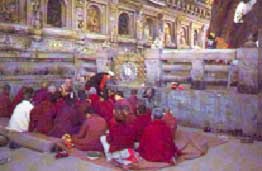
BUDDHISTS UNDER THE BODH GAYA
Some five years later, around the age of 35, after long meditation at Bodhgaya, near Gaya in Bihar, he attained Bodhi or enlightment while sitting beneath a Bodhi tree after a night during which Mara, the demon, taunted him with worldly temptations.
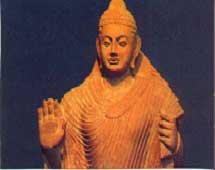
SANDSTONE STATUE OF BUDDHA, MATHURA
This became the essence of Buddhism. He then toured India, preaching and organizing his followers into an ascetic monastic order of men and women called the Sangha. After his death in 483 BC, the Sanghas continued his teachings.
There are two main sects of Buddhist schools. The "Theravada Hinayana" or "doctrine of the elders" or "small vehicle" holds that the path to Nirvana, the eventual aim of all Buddhists, is an individual pursuit.
In contrast the "Mahayana" or "large vehicle" school holds that the combined belief of all its followers that will eventually lead to salvation.
Buddha summarized his teachings into the four noble truths,
-
Existence comprises conflict, dissatisfaction, sorrow and suffering.
-
This state is caused by selfish desires.
-
It is possible to escape this and attain nirvana and
-
The key to achieve all this is the eight-fold-path.
Eight fold path
 |
Right understanding |
|
|
Right thought |
|
|
Right Speech |
|
|
Right action |
|
|
Right mode of Living |
|
|
Right endeavor |
|
|
Right mindfulness |
|
|
Right concentration. |
In India, Buddhism developed rapidly when Emperor, Asoka, the Great embraced it. His capital was Patna and he declared Buddhism as the state religion. He put up monuments associated with the Buddha, and erected the Asoka Pillar.
Buddhist Scriptures
The sacred scriptures of the Budddhists are in Pali. The word "Pali" means simply "Text" or "sacred Text". These scriptures are called Tipitaka or Tripitaka meaning "Threefold Baskets". The three baskets of the law are
-
Vinaya Pitaka
-
Sutta Pitakka
-
Abhidamma Pitaka.
Buddhist temples
India's Buddhist temples are mostly found on the slopes of the Himalayas, in Himachal Pradesh, Ladakh and Sikhism. Buddhism's holiest site is the Bodhgaya in Bihar. The first Buddhist temples were stupas built to hold the relics of the Buddha. Unlike the other religious places these structures have no internal space for prayers, instead people circumambulate the Stupas. Later Viharas were built with the Stupas at one end. Circumambulating the Stupa should be done in a clockwise direction only.
Maharastra's spectacular rock-cut caves of Ajanta and Ellora are largely dedicated to the Buddha only. The Gombas of Ladakh are also important spiritual places for the Buddhists. The Dalai Lama, the religious head of the Buddhists all over the world lives in a monastery in Dharamsala in Himachal Pradesh.
The Buddhist trail from Sarnath to Bodhgaya attracts more pilgrims from foreign countries. Popular times of pilgrimage are full moon nights and the auspicious dates of Buddha's birth, enlightenment and death. Crowds of pilgrims clad in saffron or deep red ochre offer flowers, light oil lamps, set up flags and then go in for silent meditation, counting their beads and chanting verses from the Buddhist texts.
In modern India, both the Theravada and the Mahayana traditions of Buddhism are prevalent. Of the total number of Buddhists in India, 94 % follow the Theravada tradition and the remaining 6% who live in the Himalayas are Mahayanists. Maharastra has the largest population of Buddhists in India. The other states that account for about 1% of the Buddhist population are West Bengal, Madhya Pradesh, Arunachal Pradesh, Jammu and Kashmir, Assam, Tripura, U.P, himachal Pradesh and Sikkhim.