


DANCE
In dance, India has one of the largest repertoires in the world. There are eight main classical forms: Bharata Natyam (Tamilnadu), Kuchipudi (Andhra Pradesh), Odissi(Odisha), Kathak(Bihar), Manipuri(Assam and Manipur) Mohini attam, Kathakali (Kerala) and Yakshaganam (Karnataka).
There are four minor classical forms, Chakiarkoothu, Konishattam, Kudiyattam and Ottamthullal ,all originating in Kerala. Distinct styles of folk dances are provided by a staggering multiplicity of races, linguistic and ethnic groups and religious and social organizations. They have an unharnessed progressive growth because they are representative of the regional cultures. Folk art is identified with the common man's life, distinct from the classical form, which is clearly for the elite.
Indian folk dance is simple, yet it is not naive. Rhythm and tune- simple and often repetitive, combined with minimum use of words, and with the least number of complex musical instruments are the underscore of the folk dances of India.
Indian dance scene can be categorised as:
- Tribal dances
- Religious dances and
- Classical dances
Tribal dances
The important traditional "Brato " of Bengal is an invocational dance, favored by barren women, worshipping their presiding deity after their prayer for progeny is answered. The "Bihu" of Assam is part of the Bihu utsav after the harvest season is over. Both men and women perform it in daylight. The dancers sing and form themselves in parallel rows or circles. Drums and pipes accompany the dance and music.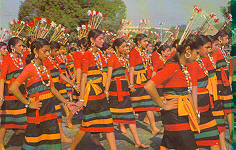
Nagaland Tribal Dance
The Lakshadweep has its own folk dance form called the "Lava". The Dadra and Nagar Haveli tribals have their charming form of "Tarpa" in which the dancers tap their feet on moonlit nights, encircling the "Tarpakar" to dance past midnight, to the accompaniment of music. The "Bhavada" dance uses masks and colorful costumes in this region. The State of Tripura, with its large tribal population of Riangs, who worship both tribal and Hindu Gods, subsists on agriculture. To ensure a good harvest they propitiate Goddess Lakshmi by a dance of young maidens called "Hawaii".
Andhra Pradesh houses many tribals like the Banjaras, Chenchus and Mathuris. In the "Dandaria dance" , apart form instruments, time is also kept by striking sticks one against the other. The Bhanjaras and the Lambadis have costumes of bright hues and skirts and blouses studded with small mirrors. Their dance called "Bhanjara" has agriculture as the main theme, with the women going round and round, clapping with gestures suggestive of agrarian occupations.
In Tamilnadu, the Toda and the Kurumba tribals have rites and rituals and festivals all centered on agriculture. Kummi and Kolattam are the two most famous folk dances performed by the tribal women of Tamilnadu. In Kummi, claps keep the beat, while in Kollattam beat is maintained by striking two sticks. Each dancer has two sticks often painted in bright colors. In "Pinnal Kolattam", some sections of the group systematically build up a visual pattern , plaiting colored ropes together, hung from a peg in the ceiling, synchronous with the music.
In course of the dance, the "Pinnal" or the plait is also slowly unwound to synchronise with the music and the ropes are back to their single-strand form, exactly when the dance and the music stop. The Muslim community of Tamilnadu have a monopoly over the dance called "Pulli Atam" where men dress elaborately like the stripped carnivore, with tail, claws, whiskers etc and dance in the streets. "Karagam" is another dance of Tamilnadu dedicated to the Goddess Mariamman, the Goddess of health and rain. Men and women balance pots of uncooked rice on their heads to the accompaniment of pipes and drums.
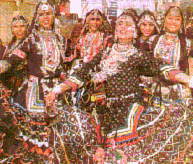
Rajasthani Folk dance
Temple dances
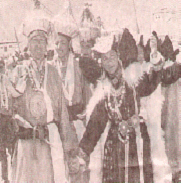
Ladakh Dance
In Goa, a Portuguese colony, "Ghode Mudne", horse presentation is very popular. Dancers in gorgeous attire, armed with swords, recapture the mood of valour and daring of the Goan warriors through movements and music. Maharastra is famous for devotional dances on the Krishna theme. The "dindi" and "Kalaa" describe Krishna's pranks. A vocalist sings to the accompaniment of the mridanga. Around them men and women dance and this takes place usually during the Ekadasi day of Karthik.
The hilly regions of North West have their "Tarpa nach" or "Parvi Nach" to offer. "Tarpha" or "Pavri" is a wind instrument made of dried gourd and is associated with the Kokna tribals. Gujarathi women appease their Goddess of fertility through a dance called "Garba". All the nine days of Navaratri festival, they perform this dance, carrying perforated earthen pots on their head with lighted lamps as they sing, clap and dance to a simple rhythm in circular formation of Goddess Durga. When men perform it, it is called"garbi".
The "bhangra" of Punjab is one of the most popular dances in India. It is performed by men during Baisakhi festival. The dancers do balancing tricks, which reveal their acrobatic skills. The dancers dress in colorful lungis and turbans. Women of Punjab perform the "gidha" which is also a group number popular during the festival of Teeyam to welcome the rains.
Haryana has its specialty in the form known as "Dhamyal" where the Duph is a circular drum played by male dancers. Men play the dance alone or with women. Lahoor is another form of Haryana, performed by women alone after their fieldwork is over.
Bihar also boasts of many famous forms. The most important dances are Karma, Jatra, and Paika. On the Ekadasi day in the month of Bhadra, a branch of Karma tree is planted and pooja is done. Then Handia, a form of rice beer is offered and the men, women and children of the dance troupe dance without any pause for three days.
The tribes of Arunchal Pradesh have a varied tradition of dances, dance dramas, pantomimes and operas based on Buddhist lore. They wear masks representing animals, demons, gods, and goddesses and perform mostly in the monasteries during festivals. The dancers of Sikkhim use masks for their Buddhist dances but they have an independent form, which deviates away from Indian traditions.
Classical Dances
All the seven or eight recognized forms of classical dance have one common root dating back to some 2000 years. It was Sage Bharata who meticulously organized and defined every conceivable element of the art of dance and put his rules and norms into his works, "Natya shastra" regarded as the 5th Veda. It belongs to 4000 B.C. Oral transmission has preserved the interpretations of scholars and teachers of yore till the present times.In ancient times an exclusive class of people dedicated their lives solely to dance and they were called Devadasis or Divine Servants. They were based in the temples and they were the authentic repertoires of the grammar and discipline of classical dances in India. The order of Devadasis gave room to the school of "Nattuvanars" or teachers to carry the banner of this divine art.
Bharatanatyam
According to popular belief, Brahma the creator devised Natya. The Rigveda gave the Lyric for it, the Sama Veda its tune, the Yajur Veda the expression or Abhinaya and the Atharveda came up with the "rasa" or the aesthetic part.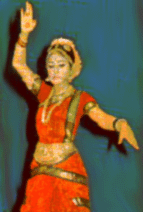
Bharatanatyam
The format of a Bharata Natyam uses an Alarippu, (invocation in nrtta) Jathiswaram, (nrtta in combination of svaras) Sabdam (love song), Varnam (perfect blend of pure dance and abhinaya) in the first half. The latter half contains lighter items like Padam (mostly lyric, music, devotional, secular or romantic) and Javali (eroticism). The concluding piece is pure dance known as Tillana with a smattering of Sahitya or words.
Kuchipudi
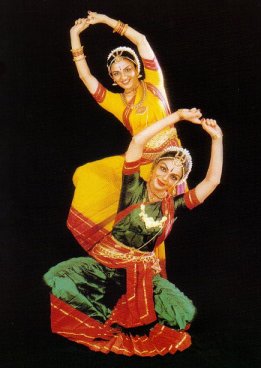
In the popular pot dance, the artist balances a water-filled pot on her head with her feet on the rim of a brass plate, which she has to move as she dances. Water should not spill from it. In another form, the dancer has to dip her toes in different pots of colored powder and as she dances, she has to trace out a colored picture on the dance floor.
Costumes and make-up are not very elaborate as in other dances. The music is carnatic and the mridanga, the violin and the clarinet are the accompaniments.The greatest contributors for the growth of Kuchipudi are Vedantam Lakshinarayana, Chinata Krsihnamurthy Tadepalli Peayya and Vempatti Chinna Satyam.
Mohini Attam
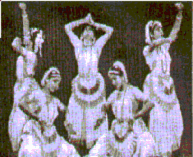
Mohini Attam
The typical "Kasavu" sari of Ekrala in captivating white with a gold border makes for the costume. The music is Carnatic. Manipravala (a combination of Malayalam and Sanskrit) is adopted in the lyrics, mainly composed by Swati Tirunal and Iraimman Thampi. Thoppi Mandalam and Veena are the accompaniment and nowadays the mridangam and Violin have replaced them.
Kathakali
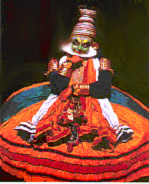
Odissi
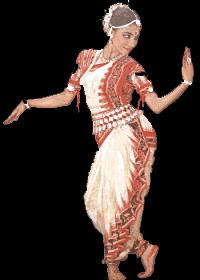
The "Trihanga", divides the body into three parts, head, bust and torso. It is the basic body grammar of Odissi. It takes after Bharatha Natyam for"hasta mudras" and "abhinaya". Krishna is often the central character of an Odissi presentation and there is also an under stress for Lord Jagannath, the presiding deity of Odisha.
The verses of the Geet Govinda, known as "Sapta-Padi", composed by Sri Jeyadeva- a devotional poet of the 13 th century A. D. forms the basic of several pieces. The music is famous for its mellifluous flavor. The name of Guru Kelucharam Mohapatra stands out when we think of the growth of this art form, in the last century.
Yakshagana
Yakshagana is the major art form of Karnataka. The 'Bhootha' dance is another ritual prevalent in the state. Here the dancer paints his face with bright yellow colour. He performs frenzy dances and is believed to get influenced by spirits. With dance, drama, music, colour, Yakshagana is a grand spectacle.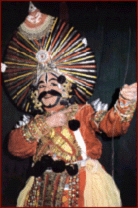
Stories from Ramayana and Mahabharatha form the theme of Yakshagana. A typical Yakshagana dance recital starts with the entry of the musicians. The Bhagavtha, the lead musician lends voice to the characters in a stylized manner. All-important characters enter the stage from behind a hand-held curtain. Yakshagana is traditionally performed during the night.