


POTTERY, TERRACOTTA AND PAPIER MACHE
POTTERY
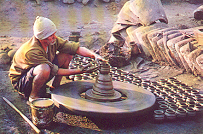
A potter in work
The advent of the Potter's wheel gave man the task of making beautifully shaped pots for his personal use. The movement of the wheel and the pressure exerted by the hands on the clay gives new shapes and forms.
Unglazed Pottery
Although the art of glazing pottery was known in India from ancient times, the finest pottery in India is of the unglazed variety. This unglazed pottery has a wide range. Very fine paper-thin pottery is produced in Kutch, Kanpur and Alwar. Alwar is known for paper-thin pottery called Kagzi.There are three different styles in unglazed pottery.
- Paper thin, biscuit colored pottery with incised patterns.
- Here the pot is polished, painted with red and white slips into intricate patterns while the outline is incised. The scrafito technique is used here.
- In this style, highly polished pottery is given strong, deeply incised, stylized patterns of arabesques. The rest of the area is covered with rows of black dots and the contrast in color and texture gives the incised area greater prominence.
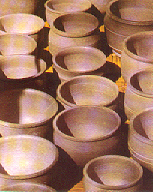
Black pottery
Nizamabad in Uttar Pradesh is noted for black pottery with silver patterns worked in it. This is similar to the Bidar work of Andhra where oxidized gunmetal is inlaid with silver wire.
Glazed Pottery
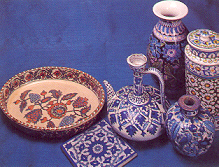
Glazed Pottery
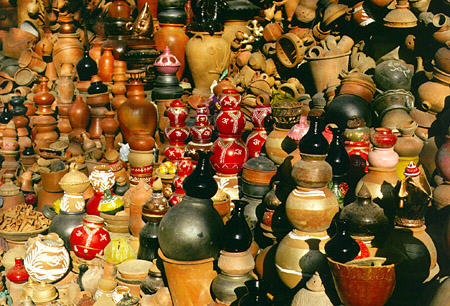
Ceramic pots of Jaipur put up for sale
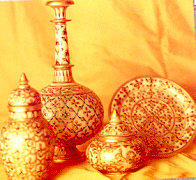
Marble inlay works
In Chunar, the raised designs in Surahis are adapted for glazed pottery. A brown slip is given finally. In Karigari in Tamilnadu, biscuit ware is created with incised patterns and given a blue or green glaze.
TERRACOTTA
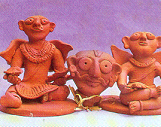
Clay toys common in India.
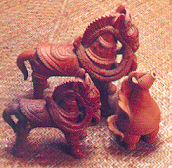
Terracotta works used
for decorations
In Bihar, Bengal and Gujarat, during festivals, the women prepare clay figures to propitiate their Gods and Goddesses.
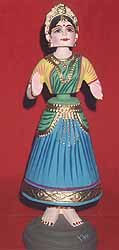
Tanjore doll
Gorakhpur in Uttar Pradesh has villages where clay figures of animals are done. The potter creates the basic form by throwing separate pieces on the wheel and then joining them.
Tamilnadu is famous for the terracotta figures of the Aiyanar Deity. The figures are huge and they are found standing guard at the entrances of villages protecting the insiders from evil spirits. Gujarat also has votive figures like horses with riders, etc.
PAPIER-MACHE
In the year 1398, when India was invaded by Tamur Lane, Sultan Sikander sent his son to pay tribute to the invader. Tamur lane betrayed the agreement of his alliance with the Sultan and made his son a hostage in Samarkhand for seven years.Many craftsmen from Central Asia and Persia had accompanied Tamur Lane to India and were placed in Samarkhand as well. There this young dynamic Prince saw the strange craft made of paper pulp. He learnt the art and later when he became the king after his father's death, spread this art among the craftsmen of his region.
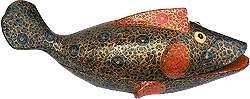
A Fish pattern made of Papier Mache