


MAKERS OF INDIA
Millions and millions of people have trodden this land of ours, thousands of leaders have evolved in course of time, a succession of social, religious and political movements have been enacted in our country.
Hence it is totally impossible to list out the makers of this great India. A few representative names are listed here. All of them remind us of the course we have traversed, and how we have came to occupy a decent position in the world.
FATHER OF THE NATION- GANDHIJI
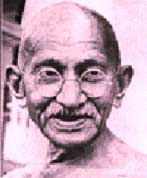 Mohandas Karamchand
Gandhi was born in 1869 in Kathiawar. He was educated in Rajkot and Bhavanagar.
Later he went to England and qualified as a Barrister in 1899. In 1893 Gandhi
went to Natal in South Africa and there he successfully organized a "Satyagraha"
in Transvaal to protest against the proposed legislation curtailing the
rights of Asian immigrants. Returning to India in 1915, he established the
"Satyagraha Ashram" at Sabarmati. In1919, he led the Non-cooperation movement
against the Rowlatt Bills. The chief items in his programme was the boycott
of British goods. Gandhi was imprisoned for six years for writing seditious
articles in his magazine "Harijan".
Mohandas Karamchand
Gandhi was born in 1869 in Kathiawar. He was educated in Rajkot and Bhavanagar.
Later he went to England and qualified as a Barrister in 1899. In 1893 Gandhi
went to Natal in South Africa and there he successfully organized a "Satyagraha"
in Transvaal to protest against the proposed legislation curtailing the
rights of Asian immigrants. Returning to India in 1915, he established the
"Satyagraha Ashram" at Sabarmati. In1919, he led the Non-cooperation movement
against the Rowlatt Bills. The chief items in his programme was the boycott
of British goods. Gandhi was imprisoned for six years for writing seditious
articles in his magazine "Harijan". Launching the Civil disobedience Movement in 1930, Gandhi chose the Salt Law as the first object of defiance and marched to Dandi in March. He moved the historic "Quit India Movement" in 1942, demanding the immediate granting of independence when the Cripps mission had failed. He was a bundle of contradictions. An acknowledged saint, he was also a self-proclaimed sinner. He preached love and compassion yet he was cruel to his wife and negligent towards his sons. Some of his ideas wee truly antediluvian. He could give up his life for a cow, yet he advocated that sex should be for reproduction only. He recognized Sardar Patel and C. Rajagopalachari as his soul mates yet he discarded them in favor of Nehru when he saw that Nehru had a glamorous appeal that others lacked. Gandhi's spiritualism did as much damage to the cause of Indian nationalism as did Nehru's personal intimacy with the Mountbattens.
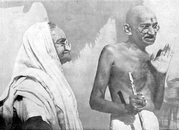
GANDHI WITH HIS WIFE
KASTHURBA GANDHI
Gandhi soared above all his contemporaries because he dealt with ideas and theories relevant to mankind. Like Buddhism, Gandhism has lost its ground where it evolved. Instead it has been embraced by many distant countries, which see in it, the promise of a peaceful life. It was his Universality, the transcendent quality of his life and thought that made Gandhi, Gandhi.