


STRANGE KINDS OF WORSHIP
In this connection, mention may be made of the elemental or atmospheric deities, demons, the elements themselves, natural phenomena, ancestors, animals and weapons.In the Vedas, reference is made to elemental gods like Indra, the god of rain, Vayu, the god of wind, and Varuna, the god of water.In the category of injury of an enemy, salutation was to be offered to Surya, the sun god, and Saraswati, the god of learning. Oblations were also to be made to Agni, the god of fire and to Soma the moon-god. Certain demons are worshipped even today in certain parts of India. The demons include Bali, Sambara, Nikumbha, Naraka, etc. the demo nesses include Chandali, Kunbhi, Tumba, Katuka, etc. Natural phenomenon is also worshipped. In the case of floods or during droughts worship was made to the Ganges, mountains and the oceans. When pestilence raged, to allay such epidemics besides worshipping the god Indra, certain rituals like milking of the cows on cremation grounds, burning the trunk of a corpse and spending the nights in devotion to the gods was done.
One of the most important Hindu rituals is the Shraddhanjali, which is connected with ancestors' worship. On the anniversary day of an ancestor such an act is performed. Perhaps the most colorful of all types is the worship of weapons. The Rajputs followed this worship mainly. On special days double-edged swords are removed from the house of arms and the entire court pays its respects.
QUAINT BURIALS
There have been certain quaint burials in our country. This practice prevailed from the 13th to the 17th century. Such quaint ideas were of ancient origin and they can be traced to Scythian times. In a specially prepared tomb, the body of the dead King was placed on a mattress, with spears fixed on the ground on either side of the corpse to support a roof. In the other parts of the square pit, various members of the king's household like his butler, cook, steward, groom and chamberlain were buried. All of them were strangled to death and laid near their master. In addition to the king's horses, his golden cups and some of his valued treasures are buried. Then a mound of sand was raised around it. There are reports of this practice having taken place in Karnataka. Loyal servants of the kings died when their masters expired either by committing suicide or by entering fire or were buried forcefully. Such an act was called Kilgunthe.There was yet another gruesome type of burial in South India, especially in Karnataka and Andhra. Certain section of people called the Lingayats who hung Lingas on their neck observed a strange ritual. They buried the wife along with the dead husband. These people dug a hole deep enough to come unto the woman's neck and placed her into it, making her to stand. Then they shovel sand around her and trampled with their feet until she was well covered. Thereafter they place a huge stone over her. A similar custom prevailed in Assam during the 17th century. When the Raja of the country dies, they dug a large tomb and placed his wives and concubines as also his horses and equipage, carpets, gold and silver vessels, grain, etc and food materials that would last for several days. Later the tomb was covered.
BREAST CUTTING
The cutting of the feminine breast has been a peculiar practice in different parts of the world including India. In India it prevailed among the Cholas in Tamilnadu and also in Gujarat. It not only existed among the Hindus but also with the Buddhists. In the Divyavadana, a Mahayana text of probably the 6th or 7th century A.D, mention is made of this practice. Buddha, in a previous birth was a woman named Rupavathi. She came upon a starving woman who was about to devour her newborn child. Thereupon she cut off her breasts and gave them to her for food. Later her breasts were restored.In Gujarat there is the story of a woman who was traveling to a neighboring village was attacked by some tribal men. Then she snatched a sword from one of them and cut off both her breasts. She then perished and she is worshipped as a Goddess still there. In the entire history of this peculiar custom the best example can be taken from the Chola period in Tamilnadu. Kanaki, on hearing that her husband,Kovalan was wrongfully sentenced for stealing an anklet of the queen, cried on the streets of the city of Madurai, then plucked her left breast and hurled it onto the streets. As this legend of Kanaki in the Tamil classic, Silapathikatram ascribed to the 6th or 7th century A.D, it may be presumed that this custom was known and practiced in the Tamil Ian country during that period.
THE MYSTIC CIRCLE
In Indian literature, whether it is Brahminical, Buddhist, Jain or Muslim, mention has always been made of the circle as Chakra or Mandala or Ivim. The circle has a mystic significance and hence its popularity from antiquity. It has been employed in social life, witchcraft, sports and many other aspects of life. In the Ramayana, Maricha, a demon tried to impersonate Rama. Sita insisted on Lakshmana going to its help. But before leaving Sita, Lakshmana anticipating trouble, drew a circle around her with the help of his arrow and asked her not to leave it, as it would bring her great danger. That circle is called "The Line of Lakshmana" or "Lakshman Rekha".The most famous concept of the circle among the Buddhists is the Dhamma Chakkar the "Wheel of Law that the enlightened one or Buddha set in motion by preaching the Law. In the Jatakas it was mentioned as being employed in fixing the eyes to induce a trance and was credited with magical powers. It has been held by some that the Buddhist Stupa was a representation of the Chakra or wheel and that it was probably an adaptation of the earlier Brahminical circle.
The circle was familiar to Indian Legists who called it the Mandala. The King, Ministers, Kingdom, Fortress, treasury and army were the five constituent parts of the circle according to them. The theory of the circle came to be employed in warfare by early Hindus and later by Muslims. It was declared that the political forms of array of an army were like those of a staff, a snake, a circle (Mandala) and in detached order.
The circle manifests itself as an element of witchcraft rituals and worship. Prior to the calling of a demon, it was necessary to draw a circle and perform the requisite rites so that it might appear personally. The circle was also connected with the worship of Lord Shiva. He is supposed to hold a Chakra in one of his hands. The circle was also employed to inveigle the unwary to death through human sacrifice.
The protective influence of the circle is preserved in the Indian folklores from ancient times. In the Panchatantra (4th-5th century), mention is made of a king Badrasena whose daughter was endowed with all the 32 excellent marks of perfect beauty and she was calledRatnavali. A certain demon visited her evening with an idea of taking her away, but she could not be neared as she drew the protective circle around her. The ring or circle was also utilized in civil and military life. In the 16th century, the Mughal King Babar, circumambulated the bed of his dying son, Humayun, and prayed that the illness may come to him. It so happened that Humayun recovered and Babar died.
The circle seems to have continued to the 19th century as well. In 1885, in the Punjab, a severe attack of cattle disease, which claimed many lives, took place. When none of the vets engaged by the Government could do something, the villagers asked for the services of a holy man. He drew a circle around the surviving herd of cattle. Then residing on horseback, he sprinkled some holy water and recited some mantras. That measure seems to have cures the cattle.
The circle appears to have survived till date, although not in its original form or intentions. In certain parts of South India, it is still used among the weaker classes.
TONGUE-CUTTING
Tongue cutting was a custom known and practiced among the Hindus, Buddhists, Jains and Muslims in India. The real motive for this practice is not clearly known, but here is no doubt that it was used as a form of punishment. Insult to the King, betrayal of the King's council, making an evil attempt against the King or disregarding the sanctity of the kitchen of the king or the Brahmanas, insulting one's father, mother, son, daughter, teacher or an ascetic invited this kind of a punishment.In the 17th century, at Nagarkot there was a famous temple for the Goddess Durga. The idol was small and short and was made of stone. Notable among the offerings to the Goddess were pieces of Human tongues. It was reported that on the next day, the tongues of those who had cut them became whole again! Such sacrifices to the gods were common in the early centuries. This custom of tongue- sacrifice also prevailed in Karnataka. According to tradition, a Kannada poet, Gopal Nyaka, frustrated in his love for a woman, he is alleged to have sacrificed his tongue to the goddess Saraswati, the deity of learning. Under the Mughals, this practice was primarily used as a punishment. There are records pointing that Emperor Huamyun and Aurangazeb used this system.
IMMERSION IN WATER
In India, emancipation from mortal life has been sought through various means and one of them is immersion in certain holy places. Such a death has been considered meritorious in the Epics and the Puranas. For example, in the Vanaparva of the Mahabharata, death at Prayag in Allahabad, implying the death in the sacred waters of the Yamuna- Ganga, was believed to be fruitful. According to the Padma Purana, one who dies in the Ganges, consciously or unconsciously, willfully or without any intentions obtains heaven after death. Various places have been chosen for this act. There were changes in the citing of the places from Prayag to different confluences or rivers from the north down to the south.The Ramayana tells how Ramachandra perished with his followers in the Saryu. The Jain work, Kuvalayamala Katha, mentions how great sins like murdering one's own father or mother even disappears from those who take bath at the confluence of the Ganges and the Yamuna. It was more of a superstition than a religious rite, as the Jains did not attach any significance with rivers. Any Brahmin, who is generally exempted from death penalty, was given the punishment of being drowned if he insults the King or his Queen.
The ancient belief that emancipation could be achieved through immersion in sacred waters of any holy river was persistent mainly in the 7th century and prevailed for many subsequent centuries. Even Kings followed this practice and probably the earliest ruler who slew himself at the confluence of the Ganga and the Yamuna was the famous Ganga king, Sivamara 1 who lived for 110 years. In the 9th century, a Rashtrakuta monarch called Dhruva also shared the same fate. The great chandela king, Dhangadeva, also adopted this custom. The Khajuraho inscriptions tell us that this famous king held sway over the entire earth and he lived for more than 100 years. He entered the Ganges muttering prayers and drowned himself.
Not only kings but also even ministers and common people sometimes shared this mode of death. Some 11th century writers point out that men of distinctions excepting Vaishyas and Sudras did not follow this custom. These people when they were tired of life or suffered by some serious afflictions, or some bodily defects or old age or infirmity seems to have immersed themselves in holy waters. The Brahmins and Shatriyas who were prohibited from committing suicide were allowed to drown themselves at holy rivers on an eclipse provide they employ someone to do this for them.
OATHS
There were in India, different types of oaths and their methods varied. The oaths sworn in by the kings were different from those taken by the nobles, ministers or the common people. In early days, the Brahmins played an important role in the process of oath taking but their influence waned with time.| Oaths for Kings | In early days when kings made pacts or treatise or declarations with each other taking the Oath, "We have joined in peace". In case of any apprehensions, they made agreements by swearing before a fire, a stretch of water, a plough, a brick, shoulder of an elephant, hips of a horse, front of a chariot, a weapon, seeds, scents, fruits, wrought gold and so on. They declared that such objects, being vulnerable would destroy and desert any one who violated the oath thus made. |
| Political oaths | In the early days witnesses were to be taken before Brahmins, vessels of water and a fire. A Brahmin was asked to say, "I tell the truth". A Kshatriya or Vaishya was instructed thus:" if you speak falsehood you will not attain the fruits of your charitable deeds and go about as a beggar. A shudra was meant to say, " If I utter falsehood, whatever merits I Have shall go to the king and whatever sins the king has done shall fall on me". |
| Social oaths | In Rajasthan, the turban was employed for swearing purposes. History has it, that a father on hearing that his son was made to die without any wrongdoing, threw the turban from h is head and swore not to replace it until he had taken revenge for the wrong inflicted on his son.
The betel nut is used for oath taking purposes. Betel nut is used for ratifying a marriage and is used commonly even now among certain backward classes in Tamilnadu. Among the Paraiyans here, an exchange of betel is considered as a binding oath. A betel-leaf chew when flung on the ground was considered a kind of challenge. Among the Mairs, a tribe in Rajputana on oath was taken by means of a pit and a pebble. The oath was " Swear to me secrecy and obedience in good and evil and that you will disclose al that you hear and failing that, you desire that all the good deeds of your forefathers may like this pebble (dropping it into the pit) fall into the washer man's well. |
| Cow in oaths | The cow among the Hindus has always been venerated and it played an important part in the ritual of oaths. In the 4th century BC cow dung was employed for swearing purposes. Anyone who swore by cow dung and still did what ought not to be done, was punished with the highest amercement. The sanctity of the cow was invoked even so late as the 19th century. Among the Baniyas another type of oath was followed. A Baniya, placing his hand on the venerable cow, swore this," May I eat the flesh of this animal if what I say is untrue. |
| Crocodile oath | One of the strangest types of oath was what may be termed the crocodile oath, which is claimed to have prevailed in the 17th century. In Cochin in Kerala state, a crocodile was living in a river, which the local Hindus called the crocodile of Oaths. It anyone desired to swore for some reason, he would proceed to the river bank and the swearer would place himself on the crocodile's back and say," If I swear falsely you must throw me in the middle of the river. If I swear the truth you must bring me back to the banks. |
| Weapons in Oath | There was a kind of oath by the Sword, which prevailed in Kerala, Rajputana and Gujarat from the 16th century. The King took the oath of coronation to maintain all the laws of his predecessors and o pay his debts which he had not paid' "Holding a drawn sword in his left hand and his right hand placed upon a chain lit up with many oil wicks with his fingers" and then he swore" to maintain everything with the sword". Among the Raputs in Rajputana, the most powerful oath was by their weapon with the words," By my sword and shield". |
| Oath by Libation | In some Hindu courts like those in Kashmir, a sacred oath was taken by libation (Kosha). This type of oath can be traced in the annals of our country from the 10th century. During the reign of king Sambuvardhana (935-36 AD), some adherents went to him, but he would not trust them until they proved their bona fides. So he ordered them to swear to him their loyalty by taking in his presence the oath of fidelity by Libation (Kosha). He and his trusted retainer, a Damara, placed the feet of the adherent son a sheep's skin, which had been sprinkled with blood and they mutually took the oath by means of libation, with a sword in hand. This is reminiscent of the present day practice of course, though not by libation- of requiring ministers to swear the oath of secrecy before assuming office.
In the 11th century such a practice was resumed. When Didda, the infamous and lame queen, had selected as her successor, Sangramaraj (1003-28 AD), she compelled nobles like the wicked tunga and others to swear to one another fidelity by the oath of libation. When she was assured that they would do no harm to one another and thus undermine the government she died in peace. |
| Swearing by holy books | There seems to have existed, as it is now in some places the practice of swearing by a holy book. During 542- 1565 AD, Vijayanagara Rama Raya, the king of Bijapur, used the oath taking practice in the presence of the holy Quran. In order to reconcile his ministers and nobles so that they are obedient to him, he placed a Quran in front of him when they came to pay him respects. The ministers could not breach the ordinances of their religion. |
| Oaths on the human body | There were some other types of oaths sworn on human beings either living or deceased. In regard to the living, we may cite the case of the wife of King Lakshmanasena (1185-1206 AD). When this king was in the womb of his mother, Ramadevi, the crown of the dead king was placed on her belly and all the great men expressed their loyalty to the still unborn king.
An oath in respect of the dead can be seen in the death of Ranjit Singh (1839) of Punjab. When his four queens were seated on the pile on which Ranjit Singh's corpse had been placed, his principal wife called to her side the heir of Ranjit Singh, Kurrak Singh and the Prime Minister. She made the heir take the dead Maharaja's hand in his own and swear to protect the country. |
STRANGE MUSLIM PRACTICE
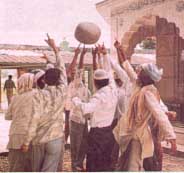
The famous stone, said to weigh around 90 Kg, can be made to rise on the index fingers of a group of nine or eleven people who must chant "HAJEE KAMARALI DURVESH," the saint's name, all the while holding the stone high. As soon as they stop chanting, the stone falls down, according to the believers. The stone slowly rises up and comes tumbling down when the people run out of breath. It is said that those who lift up the stone should consider themselves specially blessed by the saint.
Women are not allowed to try this special feat, as they are not even allowed inside the Dargah. The Saint's Urs is celebrated in early May, when large number of people visit the Dargah.
There is also another story about the powers of the Saint. When a snake bites someone, he comes to the Dargah and puts a drop of oil on the bit part from the lamp, which remains lit all the time, and he gets cured immediately, according to the people of the neighbouring villages.
The Dargah of Hazrat Peer Kamarali is located on the Pune- Satara Road, about 12kms from Pune.