


Scientific Classification:
|
Other Common Names:
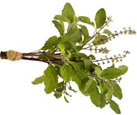
It is known as Holy Basil in English and Tulasi in Sanskrit. Other names used for the Tulsi are Manjari, Krishna Tulsi, Trittavu, Tulshi and Thulsi.Plant Description
Cultivation methods:
Tulsi seeds germinate easily without much effort and care. The seeds are mainly sown in the spring season. They are watered from time to time and germinate in one to two weeks. Tulsi prefers rich soil for its growth. It requires full sunlight.Habitat
It is mainly grown in the temperate climate and hence found widely distributed along the Indian subcontinent. Tulsi, grown as a pot plant, is found in almost every traditional Hindu house. The natural habitat of Tulsi varies from sea level to an altitude of 2000 m. It is found growing naturally in moist soil nearly all over the globe.Legend:
There are many legends connected with the Tulsi plant. One goes on to say that Tulsi is an incranation of a gopi who was in great love with Lord Krishna and was cursed by his consort Radha. Another legend says that Tulsi is an incranation of Goddess Mahalakshmi who as born as Vrinda in her previous birth. Then she was married to a demon king by the name Jalandhar. She was a great devottee of Lord Vishnu.
Medical Uses:
- It is known to promote the longevity of life.
- The extracts obtained from the plant are extensively used for curing various diseases such as the common cold, inflammation, malaria, heart disease, headaches etc.
- Antifertility effect - One of the major constituents of the leaves, ursolic acid has been reported to possess antifertility activity without any major side efffects.
- Anti diabetic effect -Use of tulsi leaves over a period of time is found to have reduced the blood sugar levels in diabetic patients by a considerable effect without any side effects.
- For Heart ailments - As it has a positive effect over blood pressure and also a de-toxicant, its regular use prevents heart attacks.
- Water boiled with tulsi leaves and cooled is effective to bring down fever .
- Tulsi is also used in treating respiratory disorders like bronchitis, asthma, influenza, etc.
- Tulsi leaves, when taken with honey can expel kidney stones.
- A healthy person can chew four to six tulsi leaves a day. It brings several benefits like normal blood sugar levels, healthy heart, prevention of ulcers, higher levels of physical endurance, lowered blood cholesterol level .
- It lowers instances of production of adrenal hormones commonly associated with stress.
- Tulsi leaves have mosquito and head lice repellent properties.
- They are also used in treatment for insect bites.
- Essential oil of Tulsi have antibacterial,antifungal and antiviral properties.It inhibites the growthof E coli, B.anthracis, M.tuberculosis etc.
Other uses:
Many people wears the Tulsi beads, which is said to have certain physical and medicinal properties. Its wood is considered as more powerful than any other gem that helps in protecting one from the negative influences vibrating around.
Cultural Importance:
Hindus perform special Tulsi puja in the Kartik month which starts after Sharad Poornima. It is the time of the Tulsi vivah (marriage). On this day Tulsi is decorated and coloured as a bride.