Red Panda
Introduction
Page 1 of 6
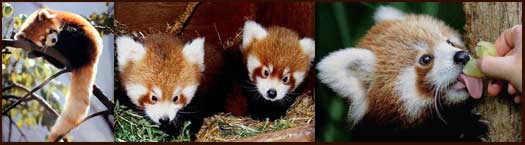
The cute Indian Red Panda can be listed among some of the top rated beautiful wild animals.
She has such a wonderful look and is scientifically called as Ailurus Fulgens. It belongs to the family Ailuridae and order being the Carnivora. It comes under the super family Musteloidea.
Another list which only a very few species might have is that Indian Red Panda has a long list of nick names called by and they are Cat Bear, Bear Cat, Bright Panda, Common Panda, Fox Bear, Fire Fox, Himalayan Raccoon, Lesser Panda, Nigalya Ponya, Panda Eclatant, Panda Chico, Panda Rojo, Petit Panda, Red Fox, Poonya, Crimson Ngo, Red Cat, Sankam, Small Panda, Thokya, Wah, Woker, Wokdonka, and Ye.
| Kingdom | Animalia |
| Phylum | Chordata |
| Class | Mammalia |
| Order | Carnivora |
| SubOrder | Caniformia |
| Superfamily | Musteloidea |
| Family | Ailuridae |
| Genus | Ailurus |
| Species | A. Fulgens |
Physical Structure
Indian Red Panda is much alike with face appearance as a raccoon. It grows upto a maximum height of 50 to 60 cms and can weigh in the range of 3.5 to 6 kg at a maximum. Usually the male pandas are larger in size compared to that of a female having a difference of about 2 kgs.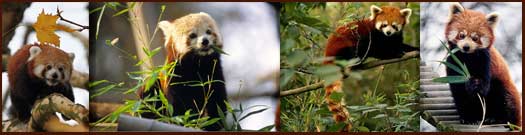
Page 2 of 6
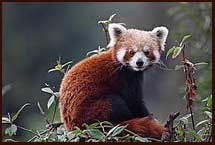
It has smooth and soft fur covering its body that is of a combined colour of reddish orange appearance, while at the back of its body the colour is different,
which is black that protects from cold. Being a Panda, its paws are having the nature of grasping the stem of trees like Bamboo, to climb and hold still while eating, also to hold the twigs of trees in the forest. It has a long tail that may be ringed and extend upto a three by fourth of its measure is bushy and its length is about 20 to 50 cm. The legs are shorter and has thick soles at the bottom that provides the Panda to move in the snowy areas.
Distribution and Habitat
Places Found
In the Indian subcontinent Red Pandas are found most widely in north eastern parts, other than Indian subcontinent the pandas are found in southeastern Asia, Himalayan Mountains in Nepal, southern Tibet, China and the highlands of Myanmar. As per the survey made in the year 2001, it was only 5000 to 6000.
Singalila National Park is located in the Darjeeling district of West Bengal State. This park is known for the endangered species of Indian Red Panda. This park is on the Singalila ridge, where the two highest peaks of the State of West Bengal, called as Sandakphu and Phalut at a height of 3630 and 3600 meters respectively are inside the National Park.
The two Rivers Rammam and Sirikhola flow through the Singalila National Park. The other wild life animals see here are Red Panda, Leopard Cat, Barking Deer, Wild Boar, Yellow throated Marten, Pika and Pangolin. Even though it is the National Park which is known for the Red Panda, a count of around 25 and more can only be seen in this park.
Page 3 of 6
Padmaja Naidu Himalayan Zoological Park : The Padmaja Naidu Park is also called as the Darjeeling Park and is covering an area of 67.56 acres.
The park was opened in the year 1958 and has an altitude of 2134 meters. This park is known for its highest park in India with highest elevation and named after the Governor Padmaja, who is the daughter of Sarojini Naidu. The zoo is famous for the conservation of Red Pandas and snow leopards. Endangered species other than Red pandas like Snow Leopards, Gorals called as mountain Goat, Sibereian Tigers and other rare birds are seen here.
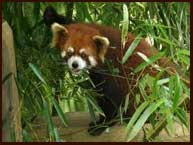
The Manas National Park covers an area of around 3840 sq. kms and is also called as Manas Tiger Reserve. The best seen wild life species are Indian Red Pandas, Wild Buffalo, Pygmy Hog and Golden Langur. Apart from these endangered species, 50 to 55 other endangered mammals are also seen here.
Namdapha National Park:
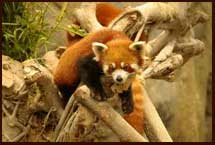
The wild life seen here are Leopards, Red fox, Red Panda, Eurasian otter, wild boars, Capped langurs, Small and Large Indian cavet, hog deer, sambar, Gaur, common Gibbons, Takin and bharal.
Page 4 of 6
The major flora and fauna here are birch, oaks, maple, fir, willow, etc and goral musk deer, Red Panda,
Himalayan blue sheep, Himalayan Tahr, Wild ass, wild dog, civet, Himalayan black bear, serow, snow leopard, sloth bear and takin.
Food habits
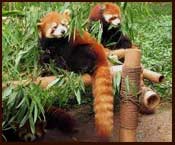
The major feeding for the Red Pandas are the bamboos and its leaves mostly. Stems of young bamboo shoots are also taken by them during the spring seasons. Red Pandas also have their diet of selected fruits, Nuts, flowers and seeds, and also some insects, birds and their eggs too. Under the captivity durations the Red Panda also takes meat. The Red Panda consumes very little calories and cannot digest cellulose, that can be said as the reason why the red panda cannot do anything other than eating or sleeping.Mating behavior
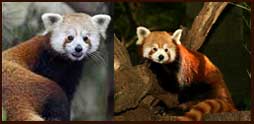
Subspecies of Indian Red Panda
- We have two subspecies of Red panda and they are,
- Western Red Panda (Scientific Name: Ailurus Fulgens Fulgens)
- Styans Red Panda (Scientific Name: Ailurus Fulgens Styani)
Page 5 of 6
Threats to Indian Red Panda
The major threat to Indian Red Panda is the killing of the animal for its beautiful thick and highly valued fur and tail.The charming animal has bad luck due its charm. The Red Panda is hunted widely for its fur in China. The decline of this rare species is still continuing apart from several conservative measures taken to protect the cute animal. The loss of habitat, and deforestation, and cutting of trees like Timber, Bamboos and Firewood collection also add to the threats for the species.
Population of Red Pandas in India
The population of Red Panda is much lesser and it was around 47 Red Pandas that were came to be know in the year 1998 by a survey in Singhalila National park. As a whole in the Indian Subcontinent it is a scare total of around 5000 .Poaching
Poaching is the major concern for many of the wild rare animals and it is applicable for the Red Panda also. The Indian Red Panda is under poaching threat for it is considered as a Pet and and is highly valued for its Fur.Conservation Efforts in India
Many conservation efforts have been taken in the process of protecting the endangered species of Red panda. Conservation measures specifically for Red Panda called as Red Panda Program was started in the year 1994 and brought individuals from Cologne Zoo, the Madrid Zoo, Belgium, and the Rotterdam Zoo. Since the animal is a solitary animal, process of captivity programs for breeding purposes are also initiated and progressing in different national parks and forests were Red Pandas are scattered. The species was declared as endangered by IUCN in the period 1996 - 2004.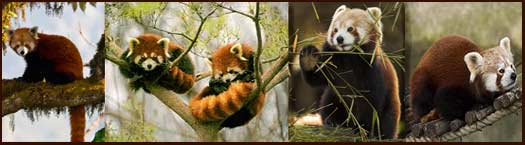
Page 6 of 6
In Arunachal Pradesh state, the local village people have formed a conservation measure known as
Pangchen Red Panda Conservation Alliance, around a forest-community area of 200 sq. kms., by five villages in it.
Interesting Facts
- Red Pandas are known for its luck and charm, hence having a bad luck for it to be under captive conditions in most places as a Pet.
- The highly valued fur of Red Pandas is used for making hats and clothing by local people in China.