


PAINTINGS
The earliest remains of painting in India belong to prehistoric times and it has not been possible to ascribe any precise date on them.
The oldest so far known are the wall paintings of the Yogimara caves of Ramgarh Hill in Madhya Pradesh, belonging to the 2nd century B.C. By the beginning of the Christian era, Buddhism became an important religion in India and the Ajanta Paintings were exclusively themed on the Buddhist religious lore. The frescoes at the Bagh rock-cut monasteries in Gwalior are contemporary with the closing years of the Ajanta glory.
Ajanta Cave Paintings
Buddhist monks employed artists to decorate the stonewalls of the Ajanta cave temples. These artists have portrayed the costumes, ornaments and styles of their lifetime. They applied mud plaster in two coats, the first was rough to fill the pores of the rocks and then a final coat of lime plaster was covered over it.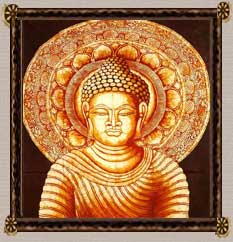
Various methods were employed to give an illusion of depth. The style of the later murals reveal a merging of two streams of art, Satavahan of Andhra and Gupta art of North India. A high degree of craftsmanship incorporating the rules laid out by ancient Indian treatises on paintings are evident from the paintings in these cave temples.
Ellora Paintings
Mural paintings are found in some five caves of Ellora but they are found preserved only in the Kailasha temple. The paintings were done in two stages; the first at the time of carving of the caves and subsequent series were the done several centuries later. The earlier paintings show Vishnu and Lakshmi with clouds in the background. The sinewy figures have sharp features. In the later series, the main composition is that of processions by Saiva holy men. Vary few murals in the Jain temples are preserved.Tanjore Paintings
The famed Tanjore paintings have rich full-bodied colors, which vie with exquisite filigree work. The themes are figures of God, Krishna being the most commonly depicted. Nowadays, birds, animals, buildings, etc are also depicted.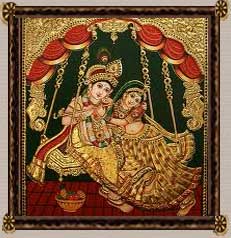
The artists favor bright luminous colors as the paintings are used for worshipping in homes and temples. Tanjore style of paintings is also drawn on glass using different techniques. The main characteristics of Tanjore paintings are their brilliant color schemes, decorative jewellery with stones and cut glasses and its chubby and larger than life figures. Another important series of wall paintings are surviving in South India in the Rajarajeswara or the Tanjore Brihadeeswara temple completed around 1000 A. D by Rajaraja Chola 1. The subjects are devoted to the Saivite religion.
Miniature Paintings
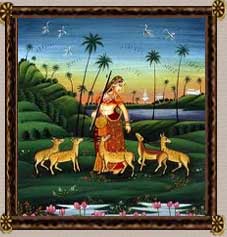
The style is like that of the Ellora caves paintings. Some illustrations were also done on papers. Miniature paintings in the western part of India had some Persian influence. In Bengal, Bihar and Odisha, miniature paintings of Buddha were done on palm leaves. They resemble the Ajanta style but on a miniature level.
History of Paintings
Islam condemned painting as sacrilege and the Quran forbids the representation of animal nature in art. So, the early Muslim rulers did not encourage any school of painting. But the enthusiasm of Akbar, the Great, really laid the foundation for the Mughal school of painting in India. There was an intermingling of Persian and Hindu strains of paintings. Mughal art in its beginning can be studied from the paintings of the Hamza- Namah.
The reign of Jehangir (1605-1627) is generally regarded as the Golden age of the Mughal paintings. Artists of both Persian and Indian origin combined to evolve a synthesis of Persian, Hindu and Western traditions, during his reign. But the King mainly encouraged Portraits of himself and his subjects. The artists of Jehangir's court developed the idea of mounting pictures with margin and extensive decorations. After Aurangazeb, the artists were totally neglected.
Meanwhile the Rajput artists based in Rajasthan had a preference for Mughal techniques and they slowly changed it into a truly Rajput one. The most popular subjects were the lovers of Krishna and Radha revealed amorously but yet tempered with refinement.
During the British period, many artists unable to find an employment worked in the Britishers houses and were told to develop paintings according to the Western taste. Art curriculums in Colleges were tuned to the western style and the Shantiniketan School founded by Rabindranath Tagore revolted against such imposed trainings.
After Independence there was another peak in the graph of Indian Art. The Progressive Artists' Club in Bombay was formed comprising M.F.Hussain F.N Souza, K.H Ara, S.K Bakre and H. A Hade.
Types of Paintings
Baroda became a new center of art and the artists created pieces that would excite the visual, imaginative and intellectual powers of an individual. In the last decade , geography and history have shed their boundaries and Indian artists have come in contact with styles and techniques form all the corners of the world. In a tangled scene of contemporary culture ,the Indian artists are struggling for self-expression. In recent years a new generation of young artists have sprouted up and they are making their presence felt nation-wide. They are mingling western ideas and Indianness in their masterpieces. Altogether the Indian painting scene is very dynamic and eclectic.
Raja Ravi Varma
Raja Ravi Varma (1848-1906), is famous for his paintings which are based on Indian mythology and Epics. He was born in Killimanoor Palace as the son of Ummba Thampuratti and Neelakandan Bhattathiripad. His uncle spotted his talent at a very young age and gave him some initial training. Later he learnt watercolor painting from the Palace artist Rama Swamy Naidu.
He learnt oil painting from the British artist Theodar Jenson. Towards the end of the 19th century, when there was a lack of vitality in Indian Painting, Raja Ravi Varma was one of the few artists who introduced Indian subjects in his work.

He learnt oil painting from the British artist Theodar Jenson. Towards the end of the 19th century, when there was a lack of vitality in Indian Painting, Raja Ravi Varma was one of the few artists who introduced Indian subjects in his work.