


Other haemaite deposits are found in Madhya Pradesh, Karnataka, Maharastra and Goa. Magnetite iron-ore is found in Tamilnadu, Bihar and Himachal.
India has the world's largest deposits of coal. Bituminous coal is found in Jharia and Bokaro in Bihar and Ranigunj in West Bengal. Lignite coals are found in Neyveli in Tamilnadu.
Next to Russia, India has the largest supply of Manganese. The manganese mining areas are Madhya Pradesh, Maharastra and Bihar-Odisha area. Chromite deposits are found in Bihar, Cuttack district in Odisha, Krishna district in Andhra and Mysore and Hassan in Karnataka. Bauxite deposits are found in western Bihar, southwest Kashmir, Central Tamilnadu, and parts of Kerala, U.P, Maharastra and Karnataka.
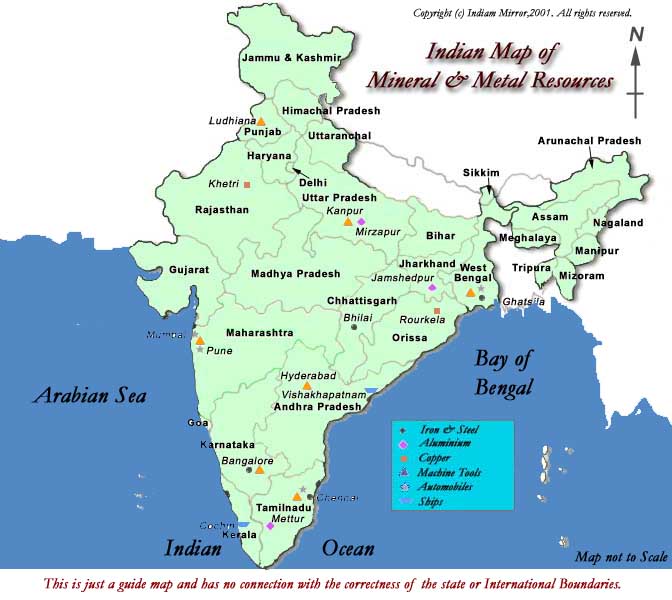
India also produces third quarters of the world's mica. Belts of high quality mica are, Bihar, Andhra and Rajasthan. Gypsum reserves are in Tamilnadu and Rajasthan. Nickel ore is found in Cuttack in Bihar and Mayurbanj in Odisha. Ileminite reserves are in Kerala and along the east and the west coastal beaches.
ss Silimanite reserves are in Sonapahar of Meghalaya and in Pipra in M.P. Copper ore bearing areas are Agnigundala in Andhra, Singhbum in Bihar, Khetri and Dartiba in Rajasthan and parts of Sikkhim and Karnataka.
The Ramagiri field in Andhra, Kolar and Hutti in Karnataka are the important gold mines. The Panna diamond belt is the only diamond producing area in the country, which covers the districts of Panna, Chatarpur and Satna in Madya Pradesh, as well as some parts of Banda in Uttar Pradesh.
Petroleum deposits are found in Assam and Gujarat. Fresh reserves were located off Bombay. The potential oil bearing areas are, Assam, Tripura, Manipur, west Bengal, Punjab, Himachal, Kutch and the Andamans.
India also possesses the all-too valuable nuclear uranium as well as some varieties of rare earths.
SOILS
Soil-types in India can be classified into three groups. The first group comprises of the alluvial, black and red soils, which are basically fertile and are arable and cultivatable.
The second group consists of the peaty and marshy, the saline and alkaline soils which are potentially arable.
The third group is the laterite and forest and hill soils, which are not at all suitable for cultivation.
The main alluvial area is found in the Indo-Gangetic plain and the Peninsular regions. The main crops are rice, sugarcane and wheat. Black soil is found in the northwestern regions and in the Deccan lava areas and Tamilnadu.
Black soil is especially suited for cotton. Red soil is particularly rich in potash and is found in northern and central India. The peaty and marshy soils are found in the Bengal deltas, Saline and alkaline soils in the semi-arid regions of Bihar, U.P, Gujarat, Punjab and Rajasthan. Desert soils are found in the minimum rain receiving areas of Gujarat, Punjab and Rajasthan. Laterite soil is common in the low hills of Andhra, Karnataka, Kerala, Madhya Pradesh, Odisha and Assam.
There are two crop seasons: Kharif, Rabi. The major Kharif crops are rice, jowar, maize, cotton, sugarcane, sesame and groundnut. The Rabi crops are wheat, jowar, barley, gram, rapeseed and mustard and the summer crops are rice, maize, groundnut and some cash crops.